
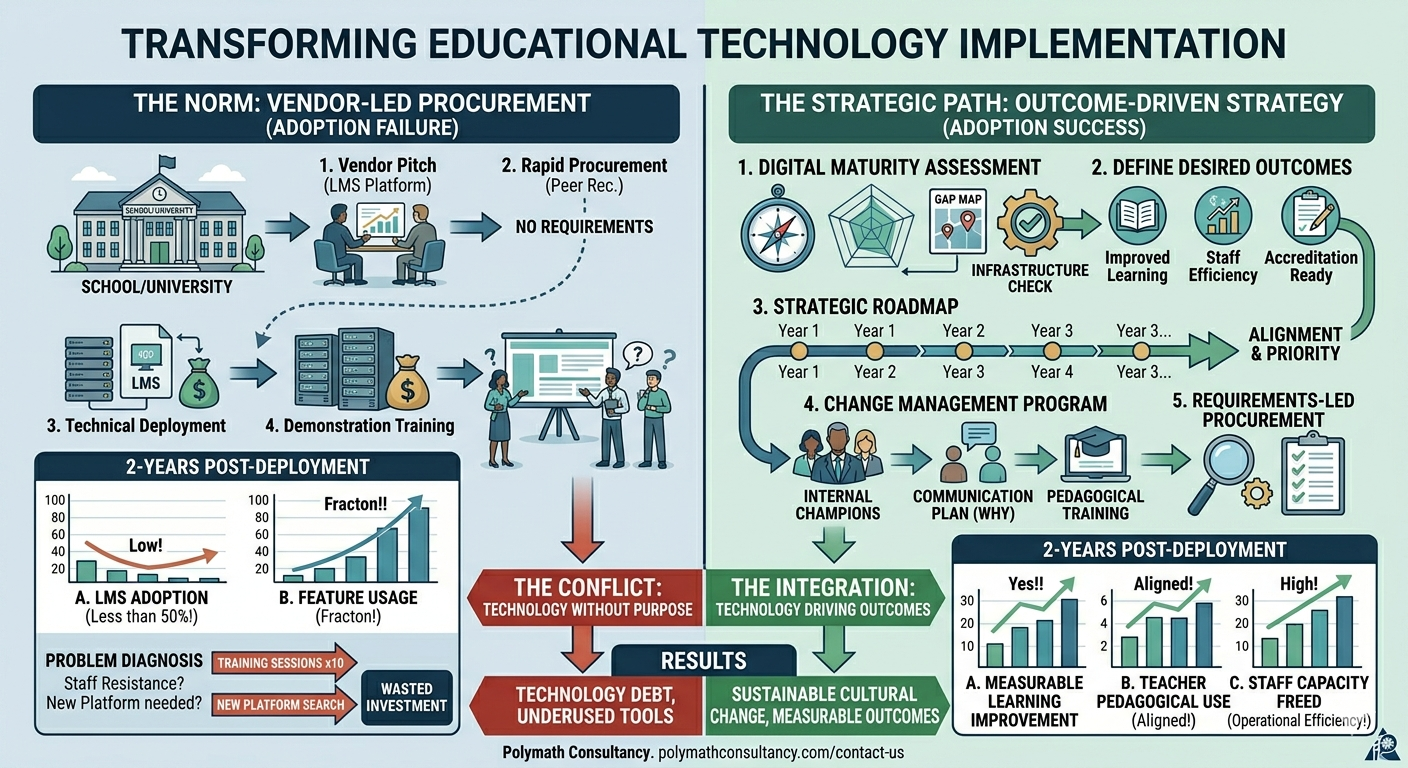
Walk into a school that’s two years into a major LMS deployment and ask the technology coordinator what adoption looks like across the staff. In a surprising number of cases, you’ll hear a number below 50%. Sometimes well below.
The platform works. The features are there. The licenses are paid and most teachers are either avoiding it, using a fraction of its capability, or doing creative workarounds that achieve what the platform was supposed to replace.
This is the normal outcome of educational technology implementation without strategy. Not the exception. The norm.
The absence of strategy is the problem
The sequence at most institutions goes like this. A platform is identified, usually through a vendor relationship or a peer recommendation, a procurement decision is made, often without structured requirements gathering. The platform is deployed. Staff are giving a demonstration. Adoption is expected. This is the biggest irony.
When adoption doesn’t happen, the diagnosis is usually that staff are resistant, that the platform isn’t quite right, or that the timing was off. Such diagnoses lead to more training, more pressure, or a new platform search. None of them address the actual problem, which is that the technology decision was never connected to a learning or operational outcome in the first place.
Digital transformation in education that produces measurable results starts with a completely different question, not “which platform should we buy?” but “what do we need this technology to achieve, and how will we know if it’s working?”
What a Digital Maturity Assessment reveals
Before any technology investment decision, an institution needs an honest picture of its current digital capability. Not a vendor readiness score but a structured assessment across teaching, learning, administration, and infrastructure that produces a maturity profile, a gap map, and a priority ranking.
This assessment almost always surfaces findings that change the investment conversation. An institution that believes it has a technology adoption problem may discover it actually has an infrastructure problem that is limiting what any platform can do. An institution planning a new LMS implementation may find that the current one has capabilities it has never deployed, making replacement premature.
The maturity assessment is the evidence base that keeps technology investment decisions rational rather than reactive. It’s also the baseline against which progress can be measured, which matters when boards and accreditation bodies start asking whether the digital transformation investment is producing outcomes.
The change management gap nobody budgets for
Technology budgets in education typically cover licenses, infrastructure, and sometimes initial training. They rarely cover change management, because change management isn’t tangible in the way that software is tangible.
Effective change management in an educational technology context means identifying and developing internal champions before launch, not after. It means building a communication plan that explains the why, not just the how. It means designing a training programme that accounts for different starting points across staff. And it means building a support structure for the period immediately after go-live, when new systems are most likely to lose the people who were tentatively on board.
Staff adoption rates that justify a technology investment don’t happen by accident. They are designed.
Connecting technology investment to learning outcomes
The most common failure mode in institutional technology reporting is measuring the wrong things. Adoption rates, login numbers, and usage statistics tell a platform story. They don’t tell a learning story.
A digital transformation KPI framework that serves institutional leadership and satisfies accreditation and board scrutiny connects technology metrics to learning outcomes. Are students demonstrating measurable improvement in the areas the technology was designed to support? Are teachers using the platform in ways that align with the pedagogical outcomes it was selected to deliver? Is the operational efficiency case being realized in ways that free staff capacity for higher-value work?
The roadmap question
For most institutions, digital transformation is not a single project. It is a five-to-seven-year change programme that involves multiple platforms, significant cultural change, infrastructure development, and a sustained change management effort. Treating it as a series of individual procurement decisions is the fastest way to accumulate technology debt and a portfolio of underused tools.
A strategic technology roadmap connects every initiative to a learning or operational outcome, sequences investments in a way that builds capability rather than creates competing priorities, and gives leadership a governance framework for making technology decisions consistently over time.
Polymath Consultancy helps schools and universities design technology strategies that connect every investment to a measurable outcome, and the change management structures that make adoption real. Talk to our team at polymathconsultancy.com/contact-us to start with a digital maturity assessment.