
Ask a school principal or university executive whether their institution has a strategic plan, and almost all of them will say yes. Ask them who owns the implementation of each priority, what the accountability structure looks like, and when the board last reviewed execution against milestones. The answers get murkier fast.
This is the central tension in institutional leadership: the gap between what a strategy says and what an institution actually does. And in almost every case, that gap isn’t caused by a weak strategy. It’s caused by the absence of governance.
Strategy without governance is just a document
There is a particular way strategic planning tends to unfold in schools and universities. Leadership retreats are held. Consultants facilitate workshops. A vision is agreed. Priorities are set. A document is produced, reviewed by the board, and distributed to staff with appropriate ceremony.
And then the operational calendar reasserts itself. Enrolment pressures, regulatory requirements, staff changes, budget cycles. The plan, which was built without stress-testing and without clear ownership at every level, begins its quiet retreat from reality. Within eighteen months, most institutions are operating without meaningful reference to it.
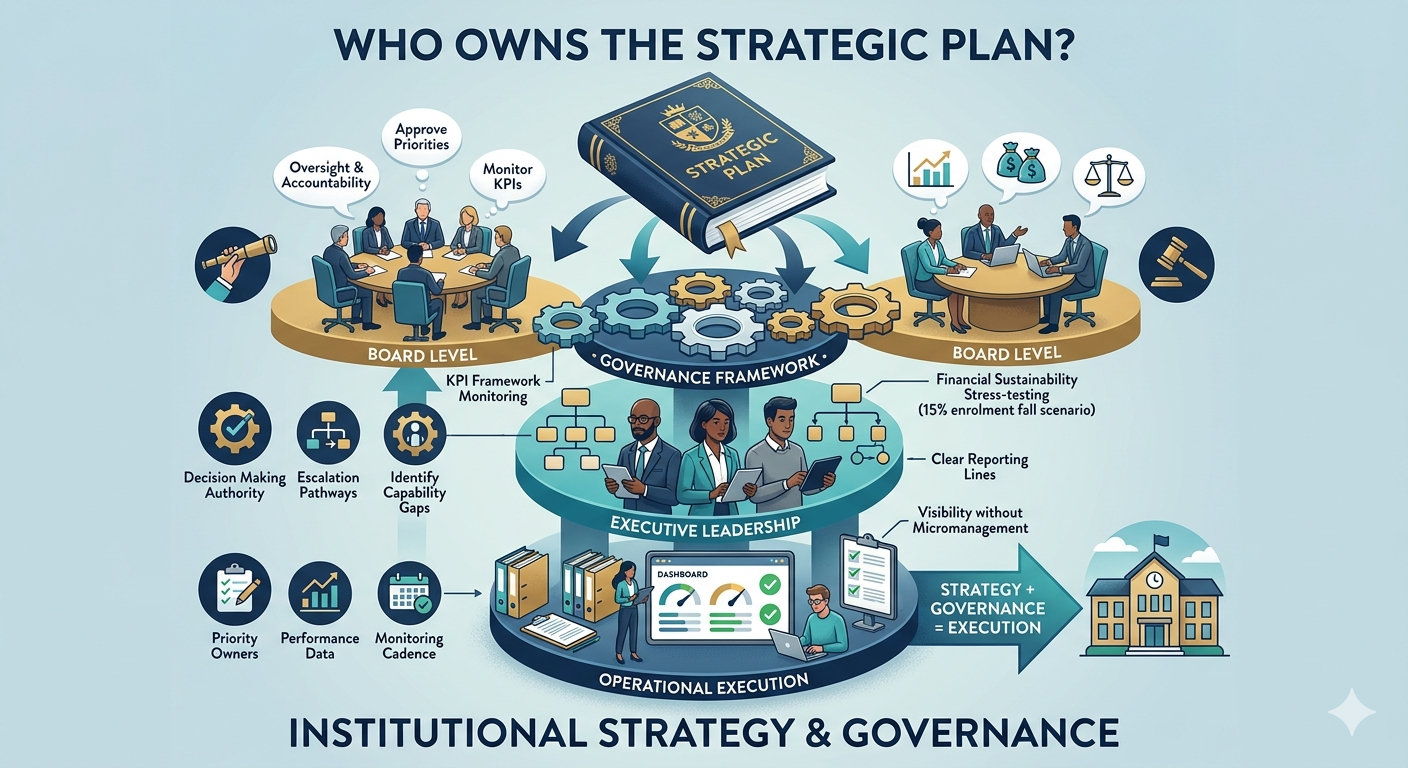
The missing element is almost always governance. Governance isn’t compliance infrastructure. It’s the mechanism that keeps strategy alive. It defines who has authority to make which decisions, who is accountable for which outcomes, and how the board maintains visibility of execution progress without being pulled into operational detail.
When governance is weak or absent, strategic decisions slow down while responsibility is negotiated informally. Accountability diffuses across roles and levels. And the plan ages without anyone quite deciding to abandon it.
What governance actually does at each level
Effective institutional governance operates differently at the board level, the executive level, and the operational level, and the design of each layer matters.
At the board level, governance defines the boundary between oversight and interference. Boards that lack clear role definition tend to either abdicate strategic accountability or micromanage operational decisions. Neither produces good outcomes. A governance framework that works defines the board’s role in approving strategic priorities, reviewing KPI performance, and holding executive leadership accountable without substituting its judgment for theirs.
At the executive level, governance creates the decision-making authority and escalation pathways that allow leadership to act without bottlenecks. An organizational structure review that surfaces duplication, capability gaps, and unclear reporting lines is not an HR exercise. It’s a prerequisite for strategic execution.
At the operational level, governance means that every strategic priority has an owner who understands what they’re responsible for delivering and by when. A KPI framework tied to strategic objectives, with a monitoring cadence and a dashboard that surfaces performance data to leadership, is what converts a strategic plan from aspiration to evidence.
The financial sustainability question boards avoid
Most institutional strategic planning conversations focus on growth, positioning, and programme development. The financial sustainability question, the honest one, gets less airtime.
What happens to this institution’s revenue model if enrolment falls by 15%? What is the real cost of the three new programmes we want to launch? What scenario does the budget need to survive that we’re currently not modelling?
Scenario-based financial analysis that stress-tests revenue models and maps sustainability risks isn’t pessimism. It’s the information that allows boards and executives to make confident long-term investment decisions rather than optimistic ones. Institutions that skip this step tend to discover their financial fragility at the worst possible moment.
Who Needs This Most
The institutions that benefit most from structured strategy and governance work are not necessarily the ones in crisis. They are often the ones that are growing, adding campuses, expanding programmes, or navigating significant leadership transitions, and discovering that the informal coordination mechanisms that worked at smaller scale are no longer adequate.
School network operators managing multiple campuses, Universities repositioning in response to market change, Education foundations trying to align programmes with funding strategy, Ministries designing system-wide reform, are the contexts where the absence of structured governance becomes most expensive, most quickly.
The starting point is always an honest assessment of the current state: governance structure, strategic clarity, financial resilience, KPI quality, and stakeholder alignment. That assessment is uncomfortable. It is also the only honest foundation for a plan that will survive its first year of execution.
Polymath Consultancy works with school principals, university executives, and ministry officials to build institutional strategies grounded in data and backed by governance structures that make execution possible. Get in touch at polymathconsultancy.com/contact-us to start with a structured diagnostic.